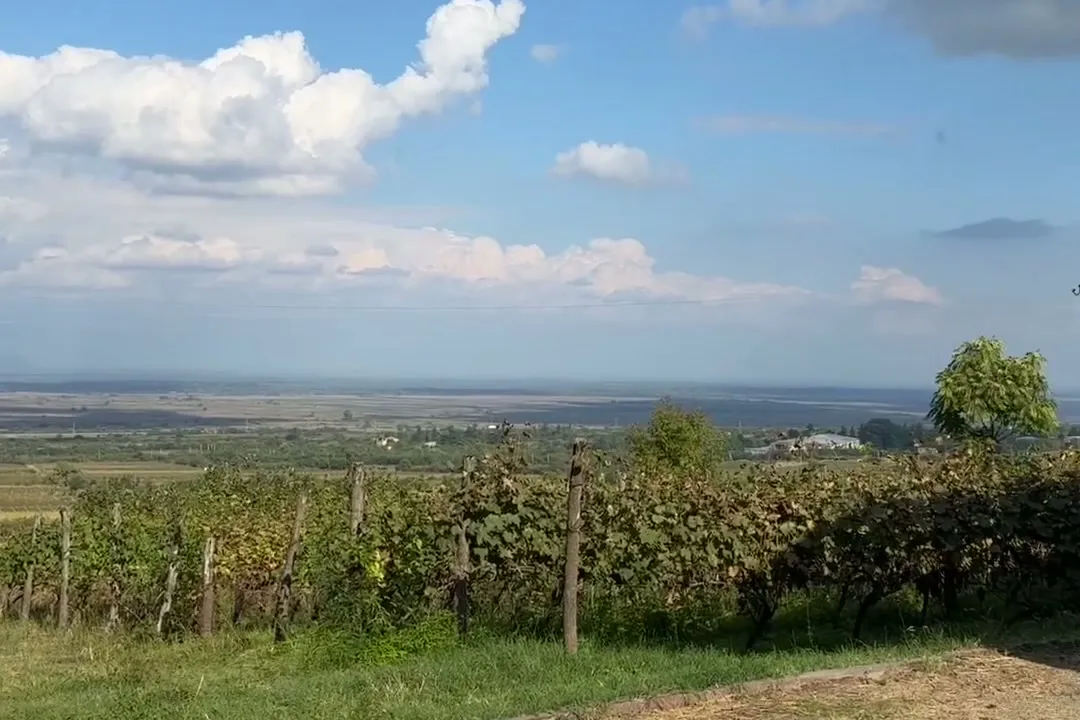
Kakheti is the wine region in the far east of Georgia, and by most measures it is the country's main one. According to the Georgian Wine Agency, it has about 65% of Georgia's vineyards and grows about 80% of the grapes that go to wineries. All three of our wines come from there.
Two valleys under the Caucasus
The region follows two rivers, the Alazani and the Iori. Most of the vines are on both banks of the Alazani, in a long valley with the Greater Caucasus along its northern side. The vineyards sit between 250 and 800 metres above sea level, mostly between 400 and 600. Summers are long and hot, and the mountains to the north spare the valley the worst of the winter cold.
The photo at the top is from our visit in the autumn of 2026, looking out from the vines across the valley.
The grapes
Three grapes do most of the work. Rkatsiteli (say r-kats-i-TEL-ee) is the white planted more than any other in Georgia; Mtsvane, a white often blended with it, brings freshness; and Saperavi (sa-pe-RAH-vee) is the red, with red flesh as well as red skin. Alongside them grow a handful of rarer native ones. On our vineyards those are Kisi, Khikhvi and a little Chitistvala.
We wrote about two of them in detail: Rkatsiteli and Saperavi.
The protected wines
Georgia protects its best-known wines by the name of the village or area they come from, the way Champagne is protected. Most of those names are in Kakheti: the Georgian Wine Agency lists 14 of the country's 18. Some are whites built on Rkatsiteli and Mtsvane, such as Tsinandali, Gurjaani and Vazisubani. Others are Saperavi reds, among them Mukuzani, Kindzmarauli, Napareuli and Kvareli. Kardenakhi gives its name to a fortified wine.
After the harvest, farmers from Kakheti and the other regions bring their produce to the capital for Tbilisoba, Tbilisi's autumn festival.
The home of long skin contact
Kakheti is the home of long skin contact for white wine. In a qvevri, the clay jar buried in the ground (also spelt kvevri), the white grapes ferment with their skins, and in Kakheti they traditionally stay together for months. The result is amber wine, white wine made like a red. The agency singles out qvevri Rkatsiteli from Gurjaani as among the best. See What is orange wine? and how a qvevri works.
Kardenakhi and Bakurtsikhe
Our vineyards are at Kardenakhi and Bakurtsikhe, two villages in the municipality of Gurjaani. The agency says Saperavi from around them makes full-bodied wines. Part of our vineyard, 4.84 hectares at Bakurtsikhe, holds EU organic certification, and the rest is farmed the same way.
We walked those vines in the autumn of 2026 with Niko, our winemaker partner, and watched the wine being made in the marani, the family's wine cellar. Our Saperavi 2019 and single-grape Rkatsiteli 2024 come from Kardenakhi, and the Rkatsiteli Mtsvane from Bakurtsikhe.
Quick answers
Where is Kakheti?
In the far east of Georgia, east of Tbilisi, between the Greater Caucasus and the border with Azerbaijan.
Is all Kakheti wine made in qvevri?
No. Plenty is made in stainless steel, in the European way. Our winemaker decides wine by wine each vintage, and the wines we chose are made in qvevri.
Sources
- Kakheti (in Georgian). Georgian Wine Agency.
- Rkatsiteli and Saperavi. Georgian Wine Agency.
- Georgia: Kakheti. Vinerra: the climate.